
How does market volatility caused by the US/Israel-Iran conflict impact your savings?
Ongoing tensions in the Middle East have continued to create uncertainty in global markets, and we understand this may feel unsettling. This update explains what’s been happening, why markets reacted and what it means for your long-term savings.
What’s happened and how have markets reacted?
Tensions involving the United States, Israel and Iran have remained elevated in recent months, with periodic military and political developments contributing to uncertainty. The region plays a crucial role in global energy supply, so any escalation can affect confidence in financial markets.
At times, concerns about disruption to key oil and gas transport routes, such as the Strait of Hormuz , have led to fluctuations in energy prices. When uncertainty rises, investors often react by moving money between different types of assets. For example, oil and gold prices may increase, while stock markets can experience short-term ups and downs. These reactions can feel significant in the moment, but markets often stabilise as events become clearer and uncertainty begins to ease.
Our view
Short‑term ups and downs are a normal part of investing, especially when global events dominate the headlines. While markets may react strongly at first, they often calm as more information becomes available. This is why taking a long‑term, balanced approach and keeping focussed on your investment goals remains one of the most effective ways to navigate periods of uncertainty.
A well‑diversified investment approach, where you hold different types of investments that may respond differently to prevailing market conditions, helps smooth the impact of short‑term movements by spreading investments across different areas. Although this doesn’t remove risk, it can reduce the effect of sudden market swings and support long‑term growth potential.
What this means for your long-term savings?
At times like this, it’s natural to feel concerned, but staying focused on your long‑term goals rather than reacting to short‑term news can help protect your future savings.
Markets have historically tended to recover quickly from periods of volatility, as illustrated in the chart below, although this cannot be guaranteed. Selling your investments after a sharp fall therefore risks ‘locking in’ any short-term investment losses suffered.
Market volatility shocks tend to be short-lived
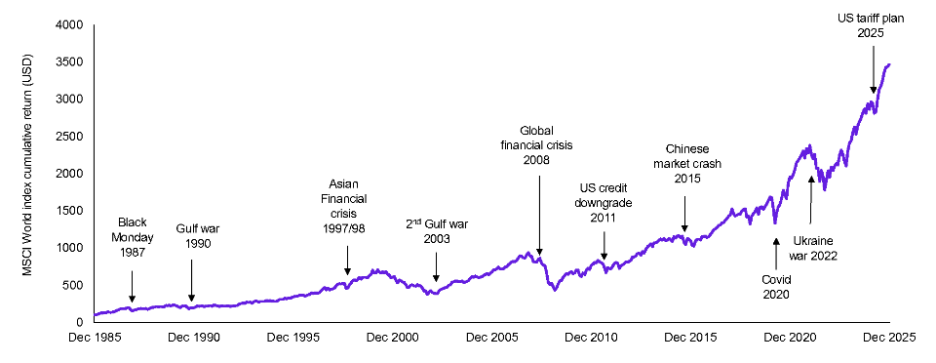
Source: Financial Express Fund Info, produced by Aegon. MSCI World index cumulative returns (USD), from 31 December 1985 to 31 December 2025. The value of investments may go down as well as up. Past performance is not a reliable indicator of future performance. For illustrative purposes only.
If you’re saving for the long term, still some way from retirement, or planning to stay invested and take your pension gradually, you’ll usually have more time for your pension savings to recover from short‑term market movements. If you’re nearing retirement and planning to take benefits soon, you may want to review your options so you understand how current market conditions could affect your pension’s value. If you’re at all unsure about your options, we recommend that you seek financial advice.
If you’re invested in a pension default fund, it may help to know that typically these funds automatically adjust as you approach retirement, gradually reducing investment risk to help protect your savings. To ensure this works as intended, it’s important that your target retirement age is correct as this determines when those adjustments begin.
The value of an investment, and any income you take from it, can fall as well as rise and isn’t guaranteed. You could get back less than has been paid in.
Additional support and information
Please read our article on Long-term investor? Here’s how to beat investment panic for more information on how to navigate market volatility.
You can find out more about your fund’s risk rating and where it invests on the fund factsheet, which can be found on the ‘Fund prices and performance’ page. If you’re not sure, Log in to your online account to see what fund you're invested in.
Please remember that Aegon can’t provide financial advice. You should speak to a financial adviser in the first instance if you need advice about your investments. If you don’t have a financial adviser, you can find one in your area by visiting MoneyHelper, or contact Origen Financial Services. Origen Financial Services Ltd, is wholly owned by Aegon UK plc but operate independently to us.