
Recent market volatility linked to the US/Israel–Iran conflict
Ongoing tensions in the Middle East have continued to create uncertainty in global markets. We appreciate that employers and advisers may be considering how this environment could influence investment outcomes, strategies and communication needs. The update below outlines what has happened, how markets have reacted and the potential implications for pension scheme members and individual investors.
What’s happened and how have markets reacted?
Tensions involving the United States, Israel and Iran have remained elevated in recent months, with periodic military and political developments contributing to uncertainty. The region plays a crucial role in global energy supply, so any escalation can affect confidence in financial markets.
A memorandum of understanding has been signed between the US and Iran, signalling an intention to ease tensions and reduce the risk of further escalation. While this is a positive step, the situation remains fluid and markets can still react to new developments.
At times, concerns about disruption to key oil and gas transport routes, such as the Strait of Hormuz , have led to fluctuations in energy prices. When uncertainty rises, investors often react by moving money between different types of assets. For example, oil and gold prices may increase, while stock markets can experience short-term ups and downs. These reactions can feel significant in the moment, but markets often stabilise as events become clearer and uncertainty begins to ease.
Our view
Short‑term market fluctuations are a normal feature of investing, particularly when global events dominate the headlines. While markets may react strongly at first, they often stabilise as more information becomes available. For both pension scheme members and individual investors, maintaining a long‑term, balanced approach and remaining aligned to their investment goals typically continues to be an effective way of navigating periods of uncertainty.
A well‑diversified investment approach can help moderate the impact of short‑term movements. Although diversification doesn't remove risk, it can reduce the effect of sudden market swings and support long‑term growth potential.
What this means for long-term savings
Periods of geopolitical tension or market volatility can naturally lead people to question the security of their savings. Although every scheme, portfolio or personal situation may be different, there are a few overarching principles that can help guide your conversations and provide reassurance.
- Long‑term investing remains important. Markets have historically recovered following periods of disruption, as highlighted in the chart below, although this cannot be guaranteed.
- Selling after a market fall can crystallise losses. Investors who remain invested typically retain the opportunity to benefit from any subsequent recovery.
- Those with longer time horizons, whether they are pension scheme members early in their careers, or individual investors with long term goals, they generally have more time for their savings to recover from short term market movements.
- Individuals approaching key life stages, such as retirement or drawing income, may want to understand how their savings and planned approach could be affected.
- Many pension default strategies include automatic de‑risking as members near retirement. It’s important that target retirement ages are kept accurate so these strategies can operate effectively.
Market volatility shocks tend to be short-lived
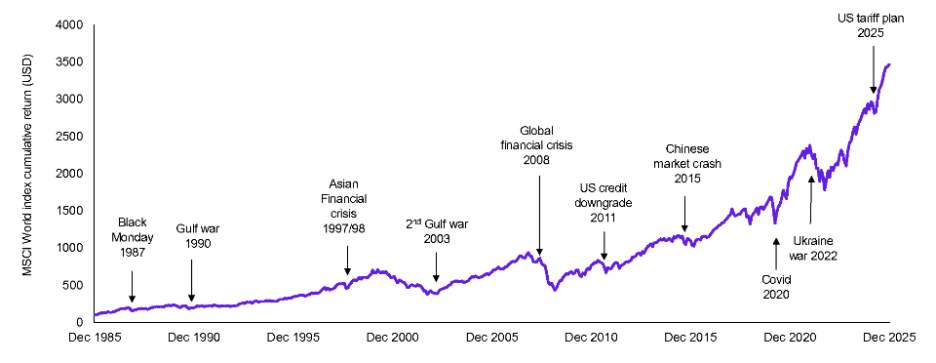
Source: Financial Express Fund Info, produced by Aegon. MSCI World index cumulative returns (USD), from 31 December 1985 to 31 December 2025. Capital at risk. Past performance is not an indicator of future performance. For illustrative purposes only.
Supporting our customers
Reinforcing the long‑term nature of investing and highlighting the value of regulated financial advice, particularly for those close to retirement or other key decision points, can help reduce the risk of investors making short‑term decisions that may adversely affect their outcomes.
To provide additional reassurance, we've shared a customer‑facing update on our website for anyone actively seeking more information, in addition, our article on Long-term investor? Here’s how to beat investment panic provides more information for customers on how to navigate market volatility.
Customers can also find out more about their fund’s risk rating and where it invests on the fund factsheet, which can be found on the ‘Fund prices and performance’ page. If they're not sure, they can Log in to their online account to see what fund they're invested in.
As always, the value of investments and any income from them can fall as well as rise and is not guaranteed. Customers may get back less than has been paid in.